
Knowledge · Ophthalmic
How are contact lenses made? Lathe cutting, cast molding and spin casting
Contact lenses are made in three main ways: cast molding, spin casting and lathe cutting. Most daily and monthly lenses are molded by the million. Custom lenses, such as rigid gas permeable, scleral, toric and keratoconus lenses, are usually lathe-cut, one by one, with a single crystal diamond tool. This guide explains the three methods, then follows a lathe-cut lens from the raw button to the finished lens.
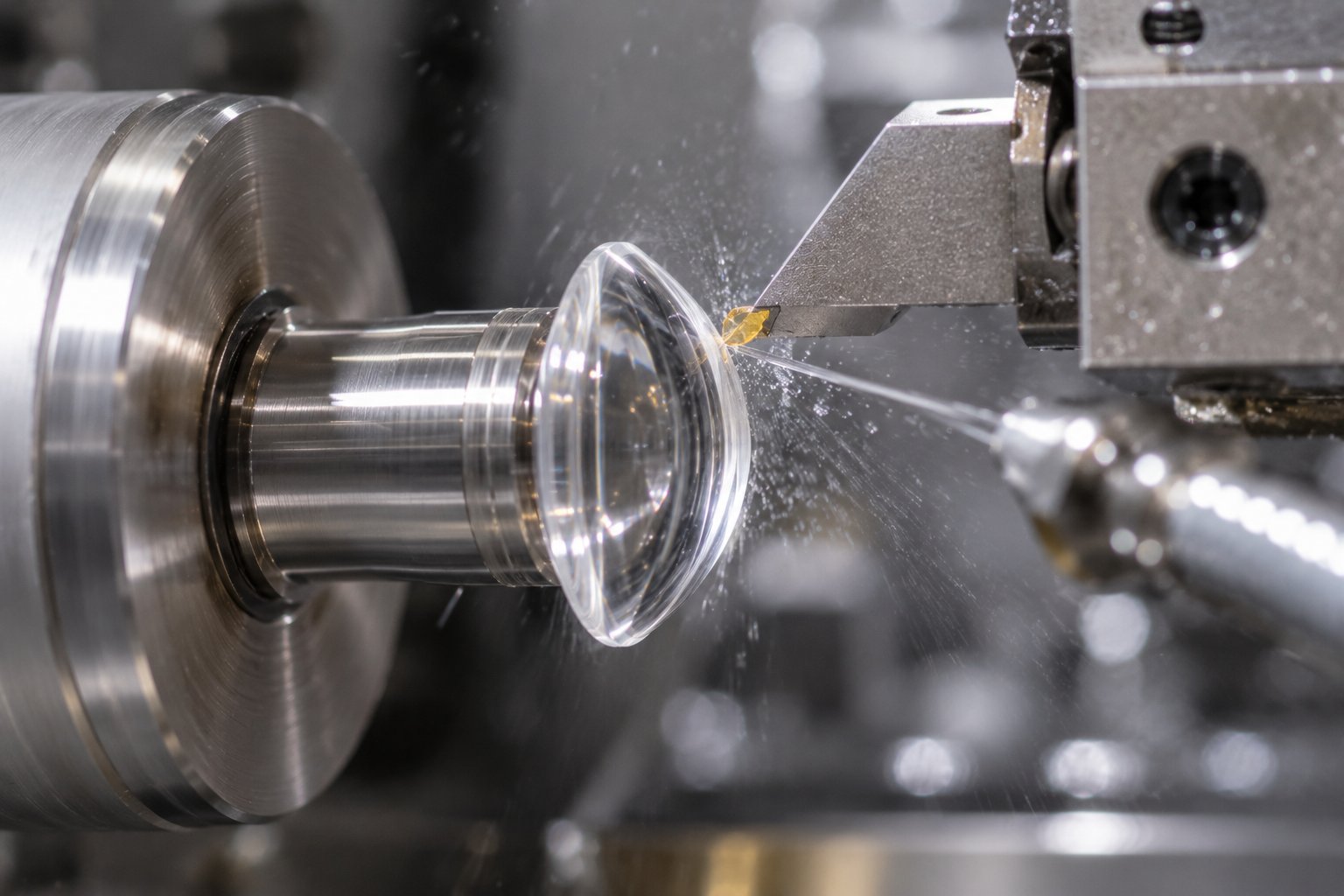
Three ways to make a contact lens
| Method | How it works | Typical lenses |
|---|---|---|
| Cast molding | Liquid lens material is cured between a front and a back mold | Daily, two-weekly and monthly disposable soft lenses |
| Spin casting | Liquid material is spun in a rotating mold and cured | Some soft lenses |
| Lathe cutting | The lens is cut from a solid button on a precision lathe with a diamond tool | Rigid gas permeable, scleral, ortho-k, toric, keratoconus and other custom lenses |
Molding is unbeatable for large volumes of the same lens. Lathe cutting is unbeatable for flexibility: any curve, any size, any power, from a single lens upward. That is why specialty and custom lens laboratories work with lathes. The molds used for cast molding are themselves often made by diamond turning.
The lens button
A lathe-cut lens starts as a button: a small disc of lens material, typically about 12 to 16 mm across and a few millimeters thick. Rigid lenses are cut from gas permeable materials such as fluorosilicone acrylates. Soft hydrogel lenses are cut while the material is still dry and hard; they only become soft when hydrated at the end.
Lathe cutting, step by step
- Mounting the button. The button is held on the lathe, on an arbor or in a holder, perfectly centered.
- Cutting the back surface. A CNC lathe with a very precise spindle turns the button while a small radius diamond tool cuts the back curve, the surface that sits on the eye.
- Cutting the front surface. The lens is turned over and remounted, and the front curve is cut. It sets the optical power, and for toric and multifocal lenses it can have complex, non-round shapes.
- Edging. The edge of the lens is shaped and smoothed, because it decides much of the comfort.
- Polishing, if needed. A light polish can remove tool marks. With a sharp diamond tool on a stable lathe, many laboratories cut polish-free.
- Inspection. Curves, thickness, power and edge are measured and checked under magnification.
- Hydration, for soft lenses. The hard cut lens is soaked; it absorbs water, swells by a known amount and becomes soft. Then it is sterilized and packed.
Why the diamond tool matters
A lens surface is an optical surface. Every mark left by the tool scatters light and can affect vision and comfort, so the cutting edge must be extremely sharp, smooth and even. That is what a single crystal diamond gives: natural diamond or MCD, polished to a precise radius, with an edge that leaves the surface optically clear straight off the lathe.
- Roughing and finishing tools: many laboratories use one tool to remove material quickly and a separate, sharper tool for the final pass.
- The tool radius and the quality of the edge over that radius decide the surface finish.
- Edge wear shows directly on the lens. When lenses start to look hazy or need more polishing, the tool needs resharpening.
- Intraocular lenses are made the same way, with even tighter demands, and their small support arms (haptics) are milled with tiny diamond end mills.
Where Bulunmaz fits
Bulunmaz makes single crystal diamond tools for contact lens and intraocular lens lathes, in natural diamond and MCD: roughing and finishing tools, inserts and haptic milling cutters, matched to your lathe's tool holder, and resharpens them. We do not make lenses. See our diamond tools for ophthalmic lathes, or send us your lathe model and current tool for a quote.
FAQ
- How are contact lenses made?
- In three main ways. Cast molding presses liquid lens material between two molds and is used for most disposable lenses. Spin casting spins liquid material in a rotating mold. Lathe cutting cuts the lens from a solid button of lens material on a precision lathe with a diamond tool, and is used mainly for custom and specialty lenses.
- Why are some contact lenses lathe-cut?
- Because lathe cutting can make any shape in small numbers, even a single lens. That is ideal for rigid gas permeable, scleral, orthokeratology, toric and keratoconus lenses, which are often made to the measurements of one eye.
- What is a contact lens button?
- A small disc of solid lens material, typically about 12 to 16 mm across and a few millimeters thick. The lens is cut out of it on a lathe. Soft lens materials are cut in their dry, hard state and only become soft when hydrated.
- Why is a diamond tool used to cut contact lenses?
- The lens surface is an optical surface: any mark left by the tool affects vision and comfort. A single crystal diamond tool, natural diamond or MCD, has an edge so sharp and even that the surface needs little or no polishing after cutting.
- What does polish-free lathing mean?
- Cutting the lens surfaces so well that no polishing step is needed afterwards. It saves time and keeps the exact shape that was cut, but it requires a very sharp, perfectly maintained diamond tool edge and a very stable lathe.
Running a machine and need the tool for it? Send us the material, a drawing or photo and the finish you need.
Request a quoteRequest a quote
Tell us about your part
Send the material, a drawing or photo, and the finish you need. We'll suggest the right tool and send you a quote.
- Email: hello@bulunmaztools.com
- WhatsApp: +90 532 561 99 62