
Knowledge · Display & Backlight
How light guide plates are made: patterns, cutting and edge polishing
A light guide plate is a clear sheet of acrylic or polycarbonate that spreads the light of a row of LEDs evenly across a flat surface. It sits behind LCD screens, inside thin LED panel lights and in illuminated signs. How evenly it glows depends on two things: the pattern on its surface, and the quality of the edge where the light comes in. This guide explains how both are made.
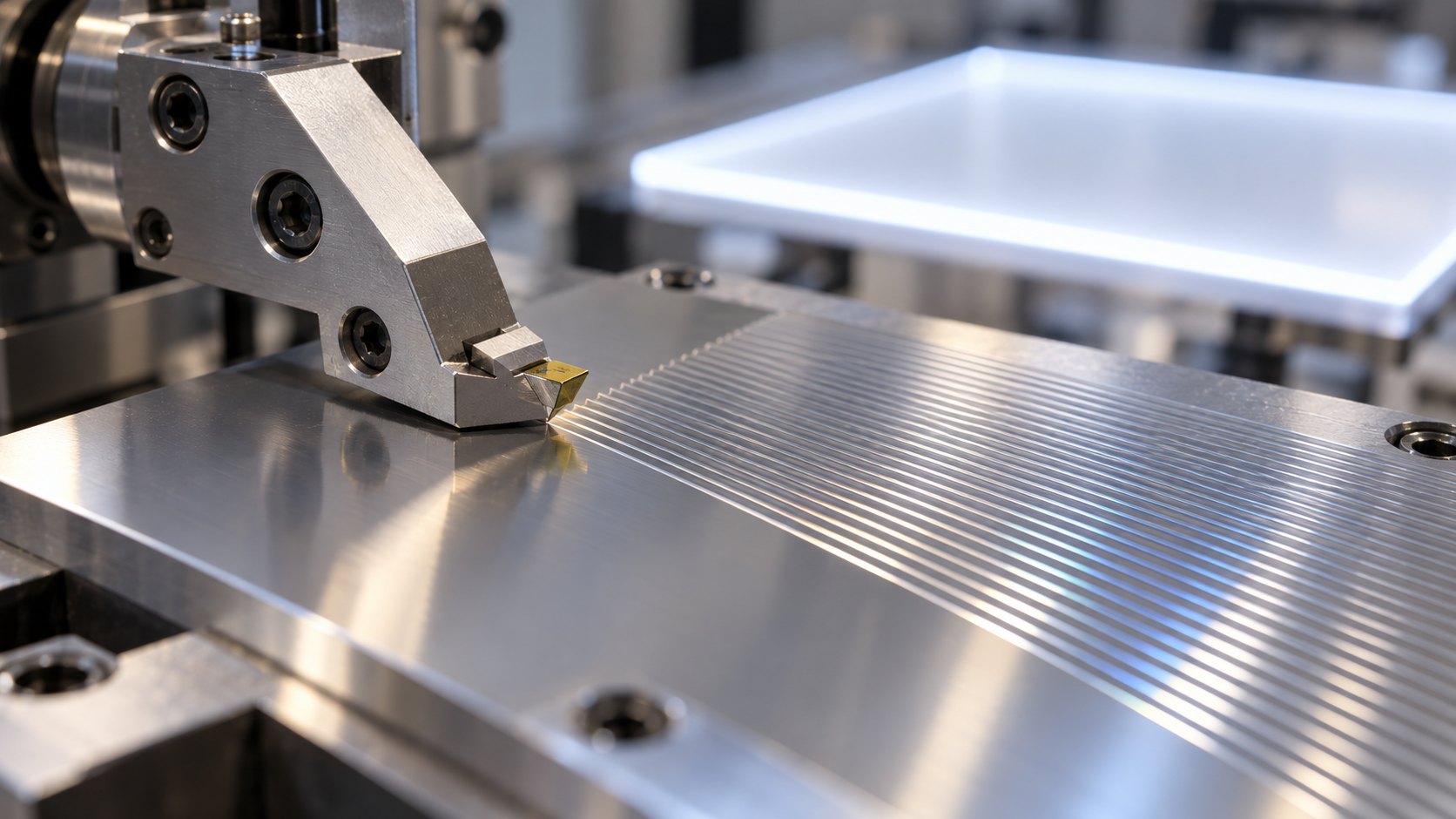
What a light guide plate does
LEDs are small, bright points of light. To make a whole screen or panel glow evenly, the light has to be spread out. In an edge-lit design, a row of LEDs shines into the edge of a clear plate. Inside the plate, the light bounces between the two faces and travels across it, trapped by total internal reflection. A pattern on one face breaks that reflection in a controlled way and sends light out toward the viewer: a little near the LEDs, more further away, so that the whole surface looks equally bright.
The plate is usually acrylic (PMMA), which is very clear, or polycarbonate where more toughness is needed. A reflector sheet sits behind it, and diffuser and prism films in front of it.
Five ways to make the light pattern
| Method | How the pattern is made | Typical use |
|---|---|---|
| Printed dots | White ink dots are screen-printed on the back face | Panel lights, signs, larger backlights |
| Laser dots | A laser engraves small dots into the surface | Panel lights, signs, short runs |
| V-cut | V-grooves are cut directly into the sheet on a V-cutting machine | Panel lights and backlights |
| Injection molded | The pattern is molded into the plate from a patterned mold insert | Phones, laptops, monitors, car displays |
| Roll-pressed | A patterned roll presses the pattern into the sheet during extrusion | High-volume sheet production |
Printing and laser engraving need no tooling and suit flexible production. V-cutting gives a clean, ink-free pattern. Molding and roll pressing are the high-volume routes, and their quality depends entirely on the mold or roll.
The molds and rolls: where the diamond tool works
Molded and roll-pressed patterns are copies of a master surface. That master, a mold insert or a roll, is often machined with single crystal diamond tools on ultra-precision machines. Sharp diamond V-tools cut fine grooves and prisms, microns deep, into nickel-plated or copper surfaces. The shape and sharpness of the tool edge become the shape of every groove, and therefore the evenness of the light. The same technique is used for the rolls that make prism films, the brightness-enhancing films in many displays.
Because one mold makes millions of plates, the tool has to cut the whole pattern with a constant edge. A diamond that wears or chips during a long pattern leaves grooves that change from one side of the mold to the other, and that shows as uneven brightness.
Cutting the plate to size
Plates are cut from large sheets by sawing or CNC routing. That leaves rough, white edges. On three sides this may not matter, because they are covered by reflector tape or a frame. The light-entry edge is different.
The light-entry edge
All the light enters the plate through its edge, so the edge has to be optically clear and flat. A rough edge scatters light at the entrance and causes hot spots in front of each LED and dark areas between them. There are three common ways to finish it:
- Diamond edge milling or polishing: a machine with a single crystal diamond cutter cuts the edge clear and flat in one pass, without heat. This is the usual choice for optical edges.
- Flame polishing: fast and shiny, but the heat can cause stress and slight distortion, which is not ideal for an optical edge.
- Buffing: possible, but slow, and it tends to round the edge.
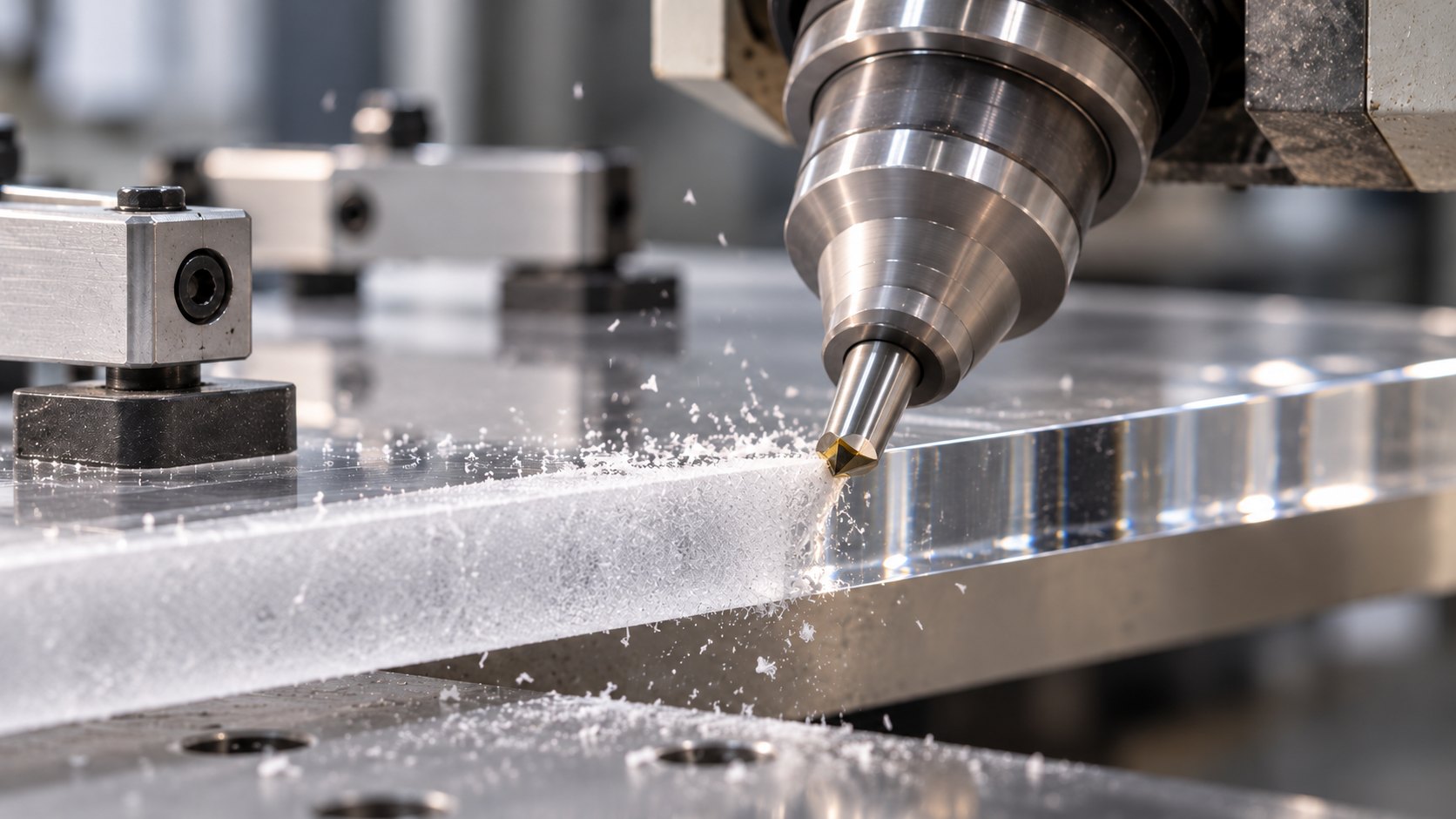
For more on finishing acrylic edges, see our guide to polishing acrylic.
Where Bulunmaz fits
Bulunmaz makes single crystal diamond tools for light guide plate work, in natural diamond and MCD: V-groove and micro-prism tools for molds and rolls, roll-mold turning tools, and edge-milling cutters for the light-entry edge, as standard tools or to your drawing, and resharpens them. Cutting V-grooves directly into the plate on a V-cutting machine is a different job; send us your machine and sheet details and we check case by case. See our diamond tools for light guide plates and molds.
FAQ
- What is a light guide plate?
- A light guide plate (LGP) is a clear plate, usually acrylic (PMMA) or polycarbonate, that takes light from LEDs along its edge and spreads it evenly over its whole surface. A pattern of dots or grooves on the plate sends the light out toward the viewer.
- How is the pattern on a light guide plate made?
- In five main ways: screen-printed dots, laser-engraved dots, V-grooves cut directly into the sheet, patterns molded in by injection molding, or patterns pressed in by patterned rolls during extrusion. Large panel lights often use printed, laser or V-cut plates; small displays mostly use molded plates.
- How are the molds for light guide plates made?
- The micro patterns in molds and rolls are often cut with single crystal diamond tools on ultra-precision machines: sharp V-tools for grooves and prisms, cutting into nickel-plated or copper surfaces. The shape of the tool edge becomes the shape of every groove.
- Why must the edge of a light guide plate be polished?
- The edge is where the LED light enters the plate. A rough or uneven edge scatters light and causes bright spots and dark areas. The edge is therefore milled or polished optically clear and flat.
- Can light guide plate edges be flame polished?
- Flame polishing makes acrylic edges shiny quickly, but the heat can create stress and slight distortion, which is not ideal for an optical edge. Diamond edge milling or diamond polishing gives a clear, flat edge without heat.
Running a machine and need the tool for it? Send us the material, a drawing or photo and the finish you need.
Request a quoteRequest a quote
Tell us about your part
Send the material, a drawing or photo, and the finish you need. We'll suggest the right tool and send you a quote.
- Email: hello@bulunmaztools.com
- WhatsApp: +90 532 561 99 62