
Knowledge · Consumer Electronics
Mirror finish on aluminum: polishing or diamond cutting?
There are two ways to make aluminum shine like a mirror. You can polish it, step by step, with abrasives and compounds. Or you can cut it, with a single crystal diamond tool that leaves a mirror surface in one pass. Polishing works on almost any shape and needs no special machine. Diamond cutting is faster, sharper and repeatable in production. This guide explains both, and when to use which.
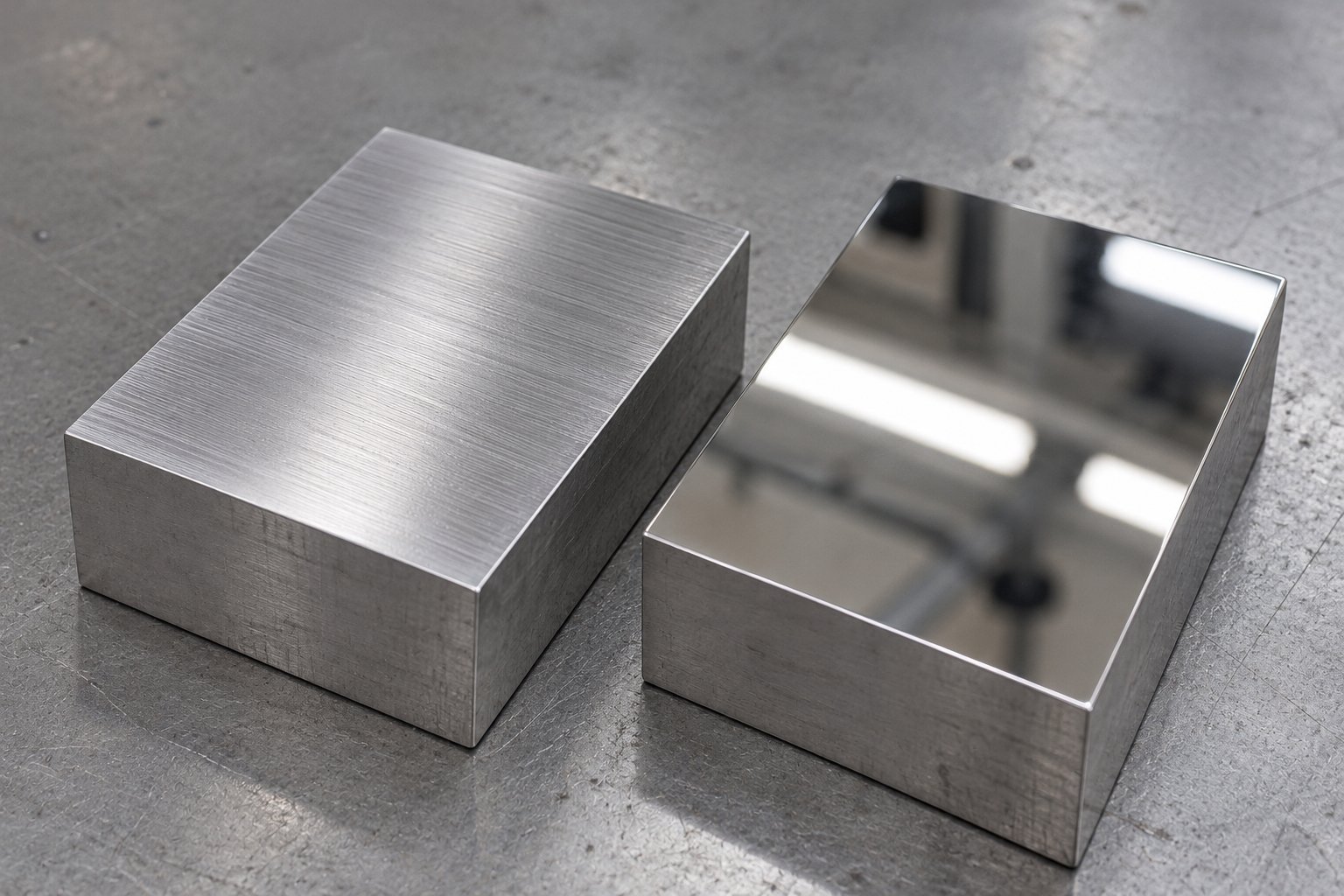
Two routes to a mirror
| Polishing | Diamond cutting | |
|---|---|---|
| How it works | Abrasives remove scratches step by step until the surface reflects | A single crystal diamond tool cuts the surface to a mirror in one pass |
| Equipment | Sanding, buffing wheels, compounds; by hand or with robots | A rigid CNC lathe or milling machine and a diamond tool |
| Shapes | Almost any shape, including curved and free-form surfaces | Shapes a tool can follow: faces, chamfers, cylinders, defined profiles |
| Edges | Edges tend to round off | Edges stay sharp and exact |
| Repeatability | Depends on the operator | The same finish on every part |
| Best for | Single parts, repairs, free-form shapes, car parts and wheels at home | Production parts: housings, chamfers, nameplates, trims, optics |
Polishing aluminum to a mirror, step by step
- Clean the part and remove any coating, oxide or old clear coat.
- Sand in stages, from a coarse grit that removes scratches, around 400, up to a very fine grit, 2000 or more. Each grit only has to remove the marks of the previous one. Wash the part between steps so no coarse grit is left behind.
- Polish with a cutting compound on a firm buffing wheel or pad, to remove the fine sanding marks.
- Finish with a fine compound on a soft wheel or pad until the surface reflects clearly.
- Clean and protect. Bare aluminum dulls as it oxidizes; a sealant, wax or clear coat keeps the shine.
Polishing gives a beautiful result, but it takes time, it is hard to repeat exactly from part to part, and it rounds edges slightly. That is fine for a wheel, a car part or a one-off, but a problem for production parts with sharp, precise features.
Diamond cutting aluminum to a mirror
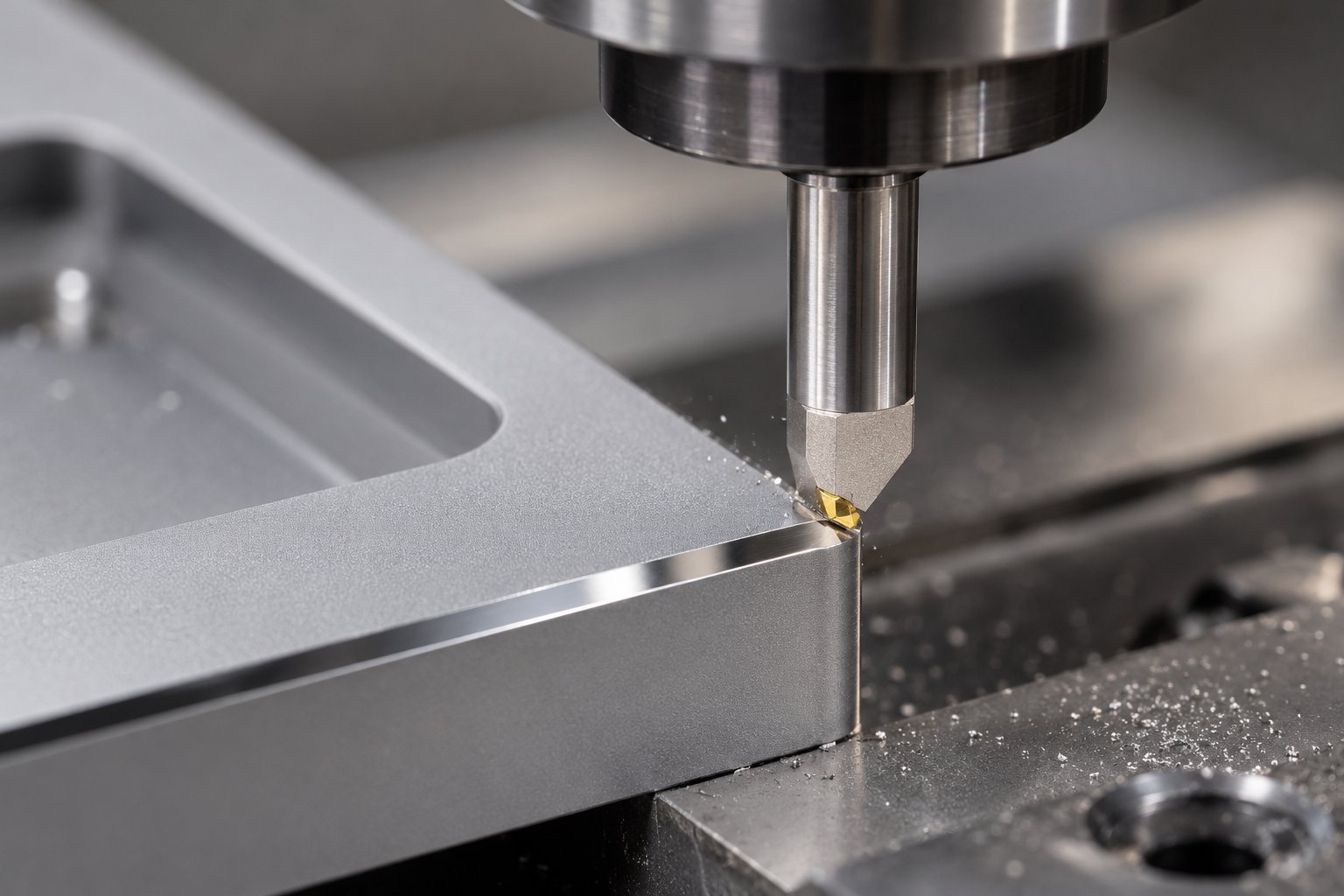
Diamond cutting skips the abrasives. A tool with a single crystal diamond edge, natural diamond or MCD, is polished so sharp and straight that the aluminum it cuts comes out as a mirror. The surface is a copy of the tool edge. Typical uses:
- Bright chamfers on phone, laptop, speaker and camera housings.
- Mirror faces on decorative trims, nameplates and logos.
- Optical mirrors and reflectors, diamond turned to optical quality.
The conditions matter: a rigid machine and a spindle that runs true, a light finishing cut, a fine feed compared with the tool radius, and a sharp edge. With those, the finish is the same on the first part and the thousandth.
Which aluminum alloys work best
- 6000-series wrought alloys (such as 6061 and 6063) and pure aluminum: excellent, the most common choice for bright parts.
- 5000 and 7000 series: good; 7000-series alloys are stronger and also cut well.
- High-silicon cast alloys: harder to bring to a true mirror, and the hard silicon particles wear the cutting edge faster.
Diamond cutting and anodizing
Many electronics housings combine both. The part is machined and anodized in its color; then the bright chamfer is cut with a diamond tool, through the colored layer, down to bare, mirror-bright aluminum. Often the part is anodized again with a thin clear layer to protect that bright edge. The result is the thin shining line around a colored housing.
Which method should you choose?
- One part, a repair, or a free-form shape: polish it.
- Production parts with faces, chamfers or edges that must be sharp and identical: diamond cut them.
- Both: some parts are diamond cut where the geometry allows and polished elsewhere.
For how diamond types differ, see MCD vs PCD and our diamond types guide.
Where Bulunmaz fits
Bulunmaz makes single crystal diamond tools for mirror finishing aluminum, in natural diamond and MCD: high-gloss chamfer cutters, face and fly cutters, turning tools and inserts, as standard tools or to your drawing, and resharpens them. We do not polish or machine parts for customers. See our diamond tools for aluminum housings, or send us your part for a quote.
FAQ
- How do you polish aluminum to a mirror finish?
- Sand the surface with progressively finer abrasive, for example from around 400 up to 2000 grit or finer, washing between steps. Then polish with a cutting compound and finally a fine finishing compound on a soft buffing wheel or pad, and protect the result with a sealant or clear coat.
- Can you get a mirror finish on aluminum without polishing?
- Yes, by diamond cutting. A single crystal diamond tool on a rigid lathe or milling machine cuts aluminum to a mirror surface in one pass. It is used for bright chamfers on electronics housings, nameplates, decorative trims and optical mirrors.
- Which aluminum alloys give the best mirror finish?
- Wrought alloys such as 6061, 6063 and other 6000-series alloys, and pure or nearly pure aluminum, give the brightest results. Cast alloys with a lot of silicon are harder to bring to a true mirror and wear diamond tools faster.
- Why does polished aluminum turn dull?
- Bare aluminum oxidizes in air and dulls over time, faster in humid or salty conditions. A clear coat, a sealant or anodizing protects the shine.
- Can a diamond-cut surface be anodized?
- Yes. On many electronics housings the part is anodized first, the bright chamfer is then cut through the colored layer with a diamond tool, and the part is anodized again with a clear layer that protects the bright edge.
Running a machine and need the tool for it? Send us the material, a drawing or photo and the finish you need.
Request a quoteArticles for housing makers
All articlesRequest a quote
Tell us about your part
Send the material, a drawing or photo, and the finish you need. We'll suggest the right tool and send you a quote.
- Email: hello@bulunmaztools.com
- WhatsApp: +90 532 561 99 62