
Knowledge · Valves & Fittings
Machining brass to a mirror finish
Brass is one of the easiest metals to machine, and one of the most rewarding to finish. With the right tool and a light final pass, a brass part can come off a CNC lathe or mill with a mirror surface, ready for plating or use, with no polishing. This guide explains how: the alloys, the tools, the finishing pass, and what to do when the surface is not bright.
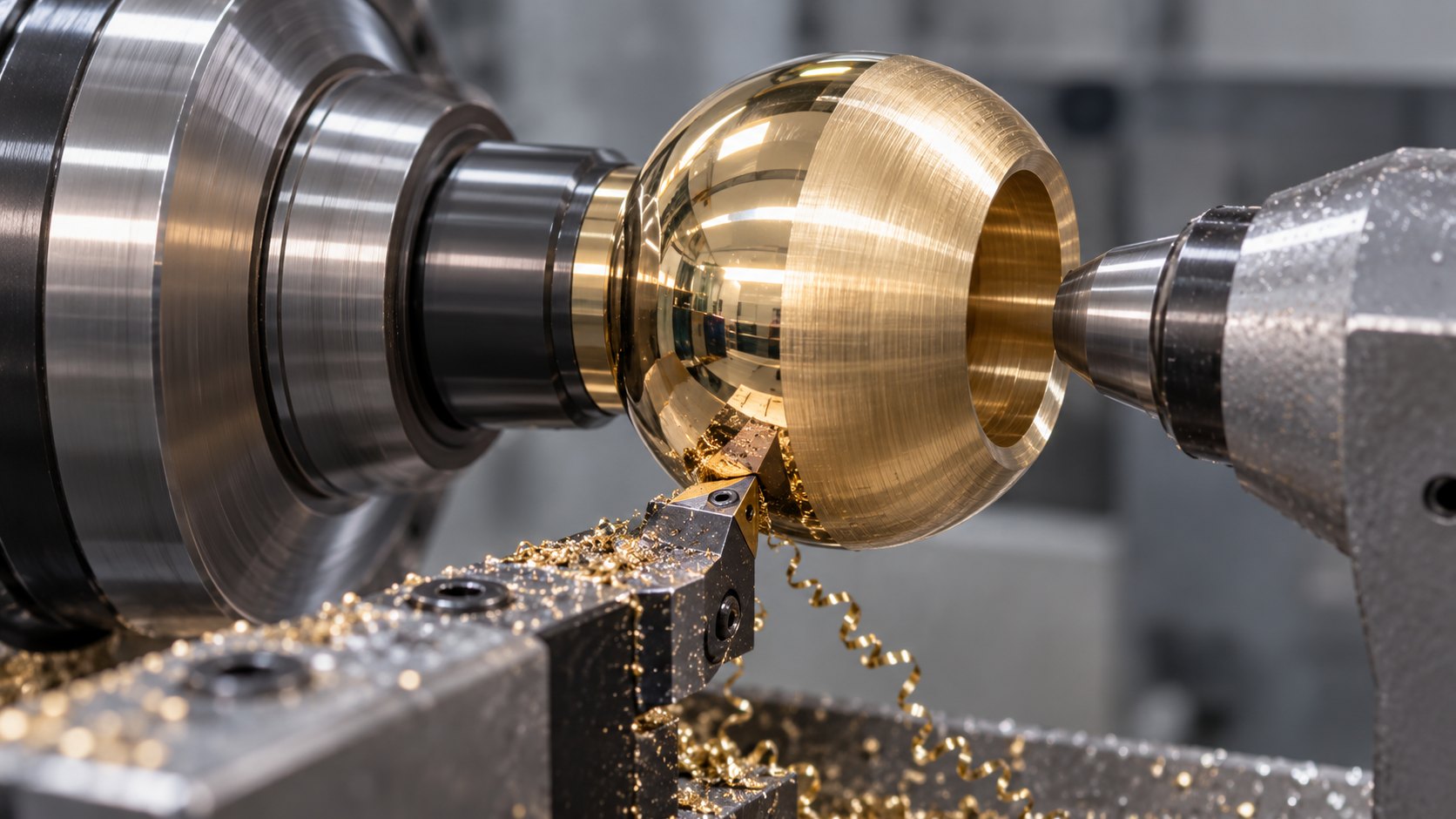
Why brass can be machined to a mirror
Brass is an alloy of copper and zinc. It is soft enough to cut easily, hard enough to hold a sharp edge on the part, and it does not stick to the tool the way aluminum often does. Its chips break cleanly, and its surface takes a high shine. That is why brass is used for valves, fittings, watch parts, musical instruments, jewelry and decorative hardware, where the finish matters as much as the dimensions.
Which brass alloys machine best
| Brass type | Examples | Machining | Typical use |
|---|---|---|---|
| Free-cutting brass (with lead) | CuZn39Pb3, CW614N, C36000 | Easiest; short, broken chips | Fittings, turned parts, watch parts |
| Dezincification-resistant brass | CW602N | Good | Water fittings in aggressive water |
| Low-lead and lead-free brass | CuZn21Si3P (CW724R), CuZn42 | Longer chips, more tool wear | Drinking water valves and fittings |
| Lead-free yellow brass | CuZn37 (CW508L) | Gummy, long chips | Pressed and formed parts |
The alloy matters more than most people expect. Lead acts as a chip breaker: classic free-cutting brass gives small chips that fall away from the part. Low-lead brass gives longer chips that can wrap around the part and scratch a bright surface, so chip control becomes part of the finishing job.
Carbide or diamond for the finish?
Carbide tools do most of the work on brass: roughing, drilling, threading, parting off. A sharp, polished carbide insert gives a clean, bright finish that is fine for most functional parts.
For a true mirror, the last pass is made with a single crystal diamond tool, natural diamond or MCD. Its edge is polished far sharper and straighter than any carbide edge, and the surface of the part is a copy of that edge. On brass, a single crystal diamond tool on a stable machine leaves a surface that reflects like a mirror, straight off the machine. It also keeps its edge for a long time on brass, so the finish stays the same over long batches.
PCD (polycrystalline diamond) is another option for long runs on brass: it lasts very long, but its edge is made of small grains, so the finish is bright rather than a mirror.
The finishing pass, step by step
- Rough with carbide, leaving a small, even allowance for the finishing pass, a few hundredths of a millimeter to about a tenth.
- Change to the diamond tool for the last pass only. Do not use it for roughing or for interrupted cuts: a single crystal diamond is very hard but brittle.
- Keep the feed small compared with the tool's corner radius. Each turn of the part leaves a tiny groove; a fine feed with a suitable radius makes those grooves too small to see.
- Keep the cutting speed steady. On a lathe, constant surface speed helps on faces, so the finish is the same from the center to the outer edge.
- Keep chips away from the surface, with clean oil or emulsion and, on low-lead brass, a tool geometry that controls the chip.
- Handle the part with care after the cut. A mirror surface shows every fingerprint and scratch.
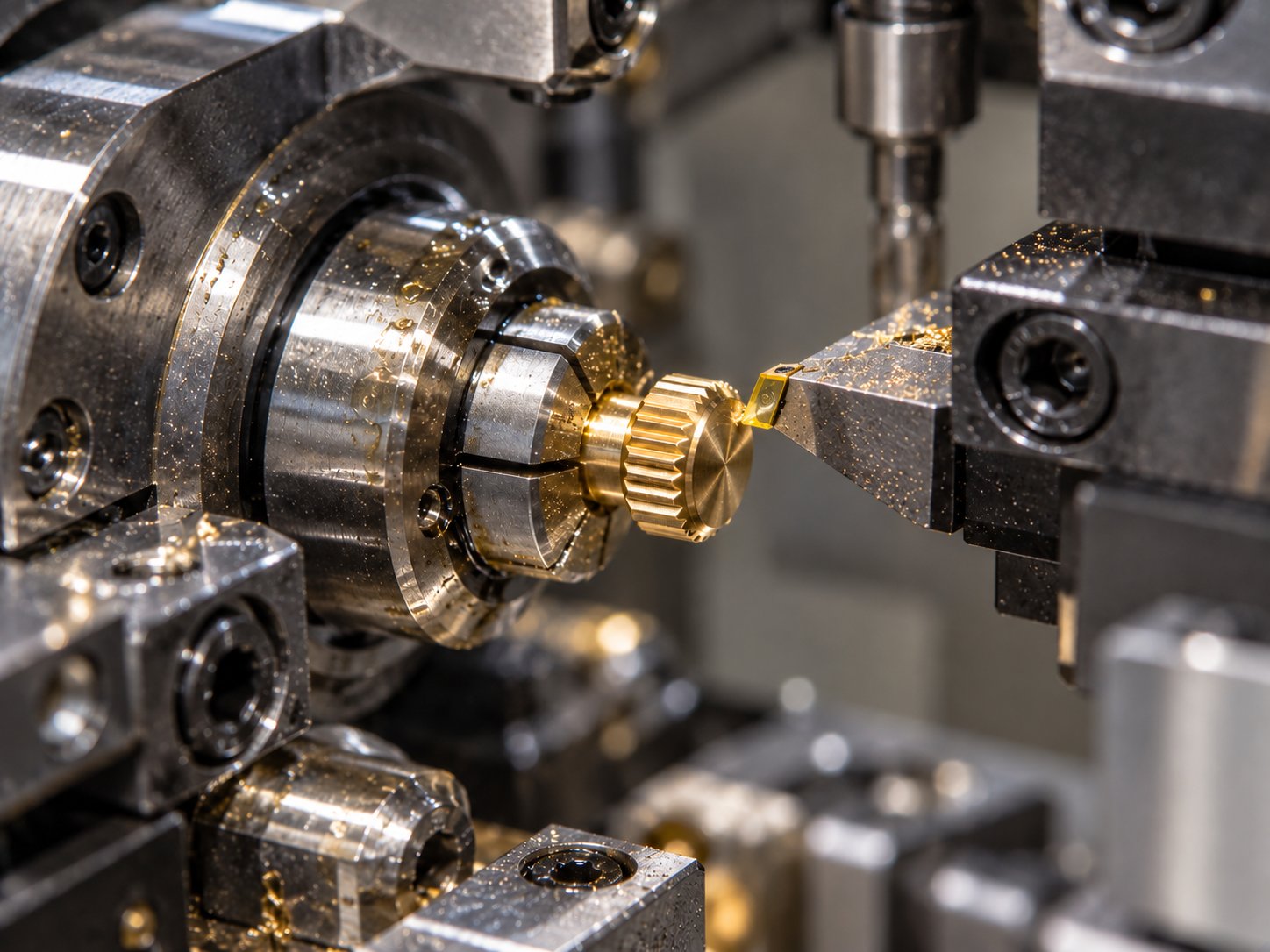
Common defects and their causes
| What you see | Likely cause | What to do |
|---|---|---|
| Hazy or dull surface | Worn tool edge | Replace or resharpen the tool |
| Fine regular rings or lines | Feed too high for the corner radius | Lower the feed or use a larger radius |
| Wavy pattern, chatter marks | Vibration: tool sticking out too far, loose part | Shorten the tool overhang, clamp more rigidly |
| Random scratches | Chips wrapping around the part, dirty coolant | Improve chip control, filter the coolant |
| Torn, rough patches | Gummy low-lead brass, blunt edge | Sharper edge, adjusted geometry and speed |
Plating after machining
Many brass parts are nickel or chrome plated afterwards. Plating copies the surface underneath: a dull part gives a dull plating, and a mirror part gives a mirror plating. A diamond-turned brass surface can go straight to plating, without the polishing step that rounds edges and costs time.
Where Bulunmaz fits
Bulunmaz makes single crystal diamond tools for the finishing pass on brass, in natural diamond and MCD: turning tools, inserts, ball finishing tools, end mills and fly cutters, as standard tools or to your drawing, and resharpens them when the edge is worn. See our diamond tools for valves and fittings, or send us your part and your alloy for a quote.
FAQ
- What is the best brass for machining?
- Classic free-cutting brass, such as CuZn39Pb3 (CW614N, C36000 in the USA), machines the most easily: the lead breaks the chips into small pieces. Low-lead and lead-free brasses are required more and more for drinking water parts; they machine well too, but form longer chips and wear tools faster.
- Can you get a mirror finish on brass without polishing?
- Yes. A single crystal diamond tool, natural diamond or MCD, on a rigid machine leaves a mirror surface in the final pass. Carbide tools give a good bright finish, but rarely a true mirror.
- Why does my brass part have a dull or streaky finish?
- Usually a worn tool edge, a feed that is too high for the tool radius, vibration, or chips scratching the surface. Check the edge first: a single crystal edge that has lost its sharpness leaves a hazy surface even with perfect cutting data.
- Should I use coolant when machining brass?
- Brass can be machined dry, but for a mirror finish an oil or emulsion helps: it keeps the part cool, washes chips away from the cut and protects the bright surface. Use clean coolant, because fine particles in it can scratch the part.
- Does brass need polishing before chrome plating?
- Not if the machined surface is already a mirror. Plating copies the surface underneath, so a diamond-turned brass part can go straight to nickel or chrome plating. This saves the polishing step and keeps edges and shapes sharp.
Running a machine and need the tool for it? Send us the material, a drawing or photo and the finish you need.
Request a quoteArticles for valve and fittings makers
All articlesRequest a quote
Tell us about your part
Send the material, a drawing or photo, and the finish you need. We'll suggest the right tool and send you a quote.
- Email: hello@bulunmaztools.com
- WhatsApp: +90 532 561 99 62