
Knowledge · Watchmaking
Swiss-type turning of watch parts: when to use a diamond tool
Many small watch parts are made on Swiss-type automatic lathes: crowns, pushers, tubes, screws, stems and small case parts. Most of the work is done with carbide tools. But on brass, gold and silver parts that will be seen, a single crystal diamond tool can leave a bright, finished surface straight off the machine. This guide explains how Swiss-type turning works, and where a diamond tool fits.
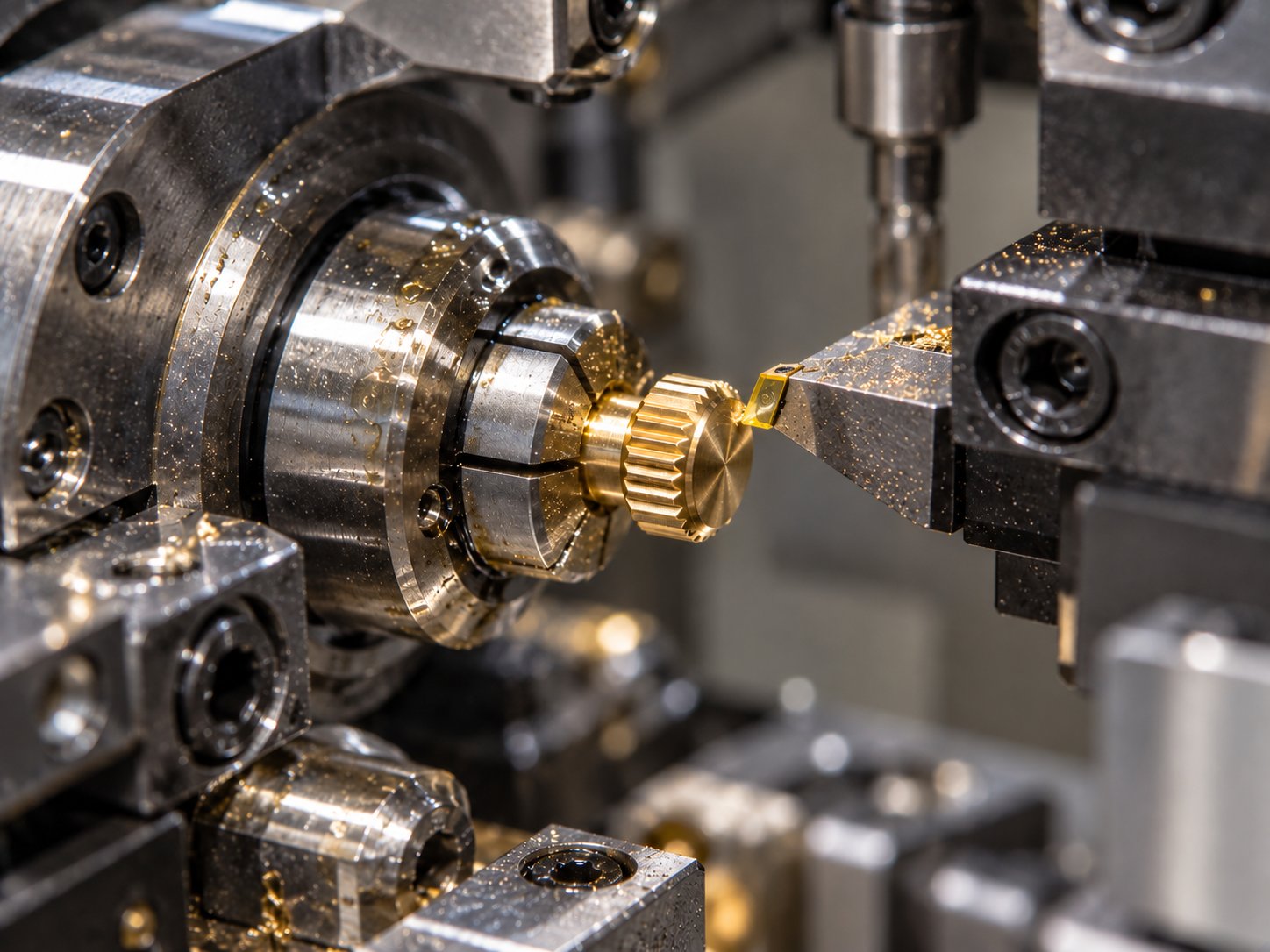
What Swiss-type turning is
A Swiss-type lathe, called a décolleteuse in French, is an automatic lathe with a sliding headstock. The bar stock is held in the headstock and pushed forward through a guide bushing. The tools cut right next to that bushing, so the bar is always supported close to the cut. That is why even long, thin parts can be turned to a few microns.
The technique was developed for the watch industry in the Jura arc, and it is still the way most small turned watch parts are made today. Modern machines carry many tools at once: several turning tools, drills, cross-working spindles and a sub-spindle that finishes the back of the part. A finished part drops off the machine every few seconds or minutes.
Which watch parts are made this way
- Crowns and pushers: the visible parts you touch, often in gold, brass or precious metal alloys.
- Tubes, stems and small case parts: made from bar stock in one operation.
- Screws, pinions and arbors: mostly in steel, sometimes in brass or gold for decorative screws.
Where a diamond tool fits, and where it does not
Most of the cutting on a Swiss-type lathe is done with carbide tools: roughing, drilling, threading, parting off. And many watch parts, such as pinions, arbors and most screws, are steel, which diamond cannot cut: at cutting temperature, the carbon in diamond reacts with iron and the edge wears very fast.
The diamond tool comes in for one job: the last, light finishing pass on visible parts in brass, gold, silver and other non-ferrous alloys. Its edge is so sharp and even that the surface comes off the machine bright, with no polishing step afterwards. On a crown or a pusher, that means:
- a bright top face and bright edges straight from the machine,
- the same finish on the first and the ten-thousandth part,
- less handling: no separate polishing, which can round off sharp edges.
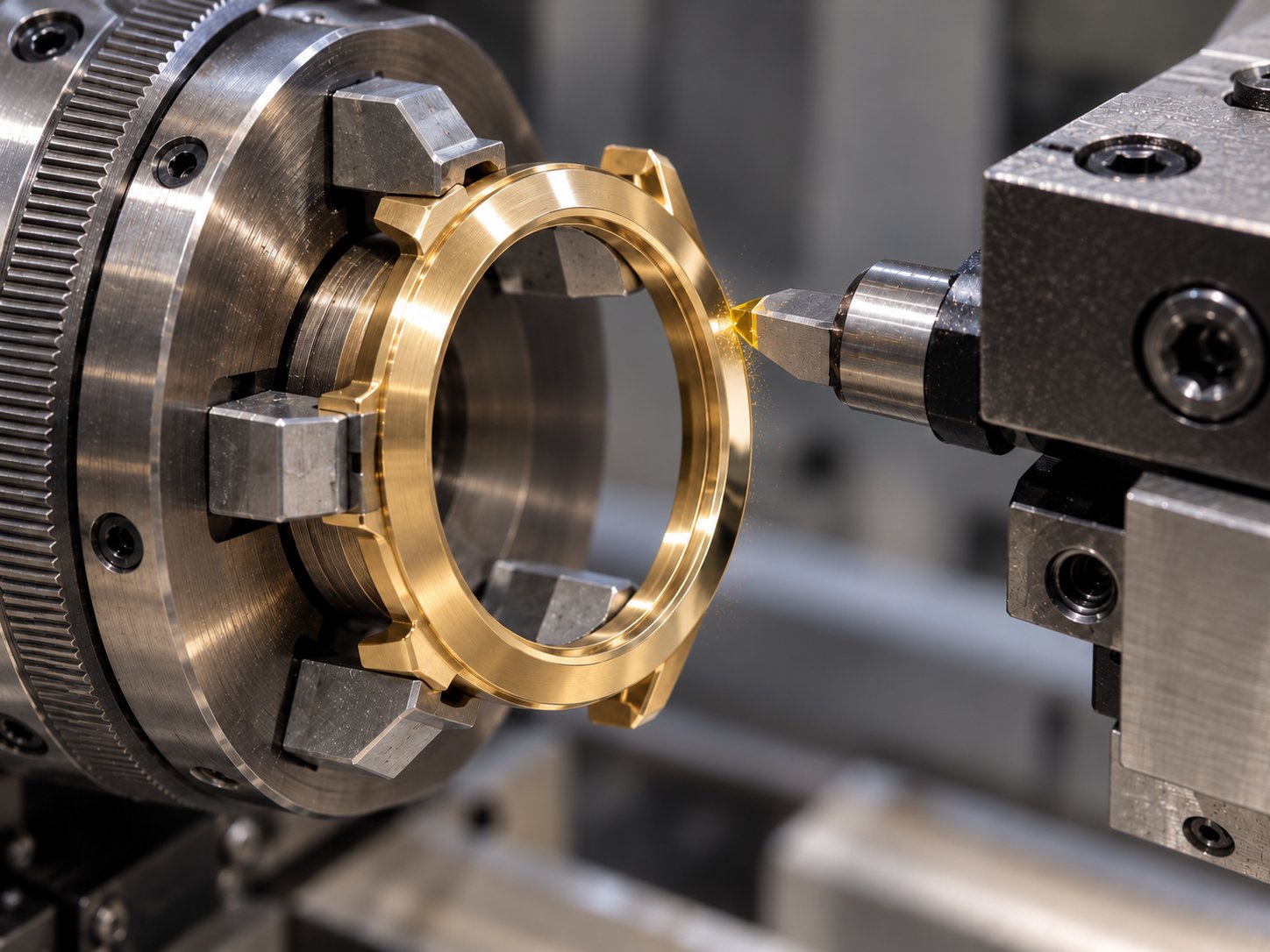
What makes a good diamond tool on a Swiss-type lathe
- The right shank: the tool has to fit the gang tool holders of your machine, usually a square shank of a set size and length. We make the tool to fit your holder.
- A light finishing cut: a single crystal diamond is very hard but brittle. It is made for a light, steady final pass, after carbide has done the roughing.
- A stable setup: the guide bushing already helps, but a worn bushing or a tool sticking out too far causes chatter, which shows on a bright surface and can chip the edge.
- Clean oil and good chip control: long brass or gold chips wrapping around the part scratch a bright surface. The tool geometry and the oil flow help keep chips away from the cut.
Low-lead brass: what changes
Watch brands and their suppliers are moving from classic free-cutting brass to low-lead and lead-free brass. These alloys break chips less easily and wear tools faster. A sharp single crystal diamond edge still cuts them well, but the cutting data and the tool geometry may need adjusting. Tell us your alloy, and we suggest a geometry that suits it.
Natural diamond or MCD?
Both give a bright finish. MCD (synthetic monocrystalline diamond) is very consistent from tool to tool, which suits series production on several machines. A selected natural diamond gives a superb edge for demanding parts. See our guide to natural diamond, MCD and CVD.
Where Bulunmaz fits
Bulunmaz makes single crystal diamond turning tools for Swiss-type lathes, in natural diamond and MCD, to your drawing or from a sample of your current tool, and resharpens them when the edge is worn. We do not make carbide tools or sell machines. See our diamond tools for watchmaking, or send us your part for a quote.
FAQ
- What is Swiss-type turning?
- Swiss-type turning, called décolletage in French, is turning on an automatic lathe with a sliding headstock. The bar moves through a guide bushing, and the tools cut close to that support, so even long, thin parts are made very precisely. It was developed for the watch industry and is still central to it.
- Which watch parts are made on Swiss-type lathes?
- Crowns, pushers, tubes, stems, screws, pinions, arbors and many small case parts. Most are made from bar stock in one operation, often with several tools working on the same part.
- Can a diamond tool cut steel watch parts?
- No. Steel and titanium parts, such as most pinions, arbors and screws, are cut with carbide or high-speed steel tools. At cutting temperature, the carbon in diamond reacts with iron and the edge wears very fast.
- Which parts suit a diamond tool?
- Visible parts in brass, gold, silver and other non-ferrous alloys: crowns, pushers, decorative screws, small bezels and case parts. The diamond takes the last light pass and leaves a bright surface that needs no polishing.
- Does low-lead brass change anything?
- Yes. Lead-free and low-lead brasses form chips differently and wear tools faster than classic free-cutting brass. A sharp single crystal diamond edge still cuts them well; the cutting data and the tool geometry may need adjusting. Tell us your alloy and we'll advise.
- Do you make diamond tools for my lathe's tool holders?
- Yes. We make turning tools with the square shank size and length your gang tool holders need, to your drawing or from a sample of your current tool, and we resharpen them.
Running a machine and need the tool for it? Send us the material, a drawing or photo and the finish you need.
Request a quoteArticles for watchmakers
All articlesRequest a quote
Tell us about your part
Send the material, the part (dial, hand, bezel, bridge...), your machine and a drawing or photo. We'll suggest the right tool and send you a quote.
- Email: hello@bulunmaztools.com
- WhatsApp: +90 532 561 99 62