
Knowledge · Watchmaking
Watch decoration finishes: which are cut with a diamond tool?
Watch decoration is full of names: Geneva stripes, perlage, sunburst, guilloché, anglage, diamond cutting. They are often mixed up, and many people assume that every bright finish on a watch is cut with diamond. It is not. This guide explains how each finish is made, where you find it on a watch, and which ones are done with a diamond tool.
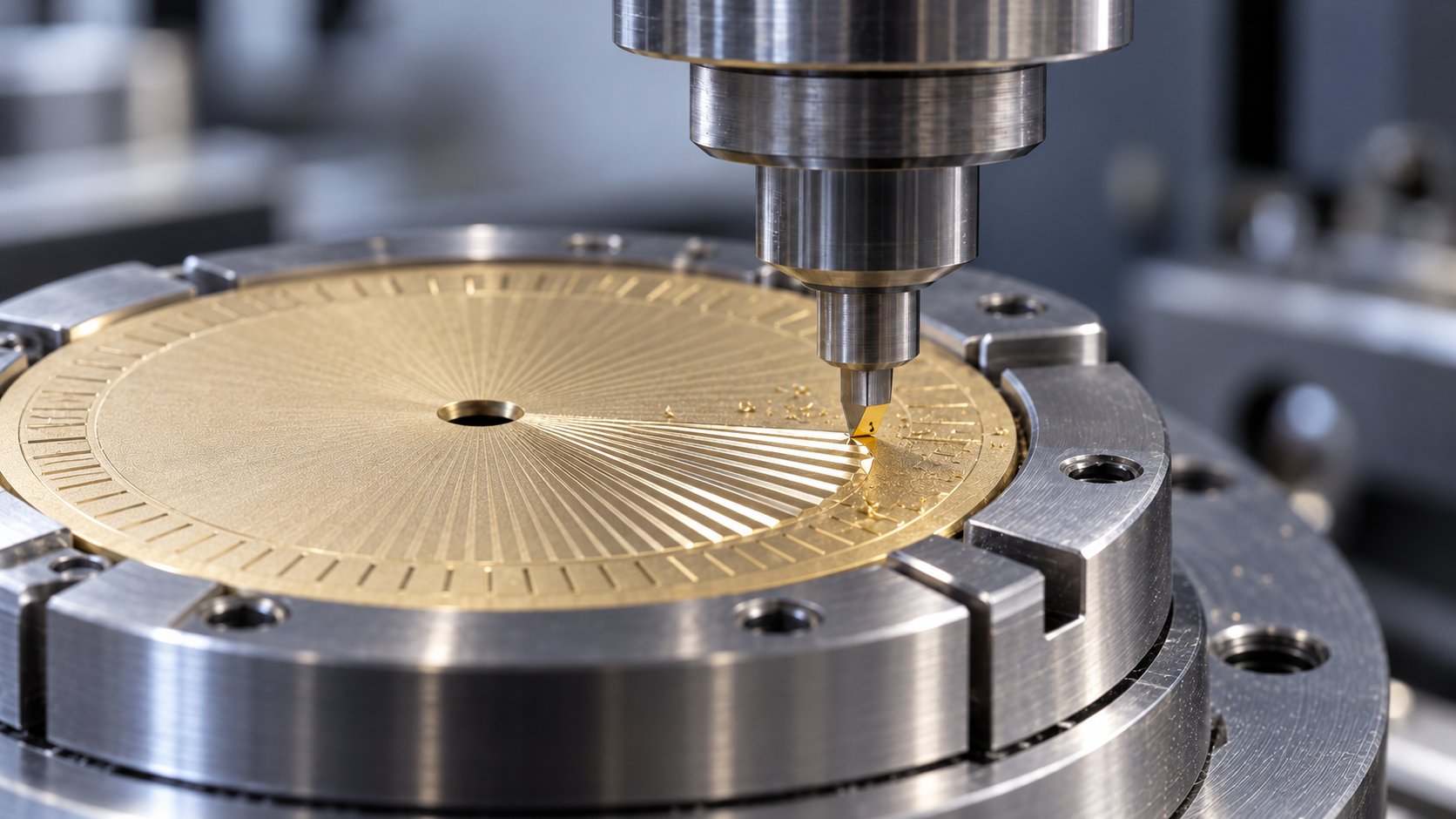
The finishes at a glance
| Finish | Where on the watch | How it is made | Diamond tool? |
|---|---|---|---|
| Geneva stripes (côtes de Genève) | Bridges, rotors | Rotating abrasive wheel or peg, straight bands | No |
| Perlage | Plates, bridges, hidden surfaces | Rotating abrasive peg, overlapping circles | No |
| Sunburst (soleillage) | Dials | Brushing, lines radiating from the center | No |
| Snailing (escargotage) | Ratchet wheels, dials | Abrasive, spiral pattern | No |
| Guilloché | Dials, case backs | Engraved on a rose engine; some modern versions cut on CNC | Sometimes |
| Hand anglage | Bridges, steel parts | Files, stones and wood, by hand | No |
| Machine-cut bright chamfers | Bridges, cases, bezels | Single crystal diamond chamfer cutter | Yes |
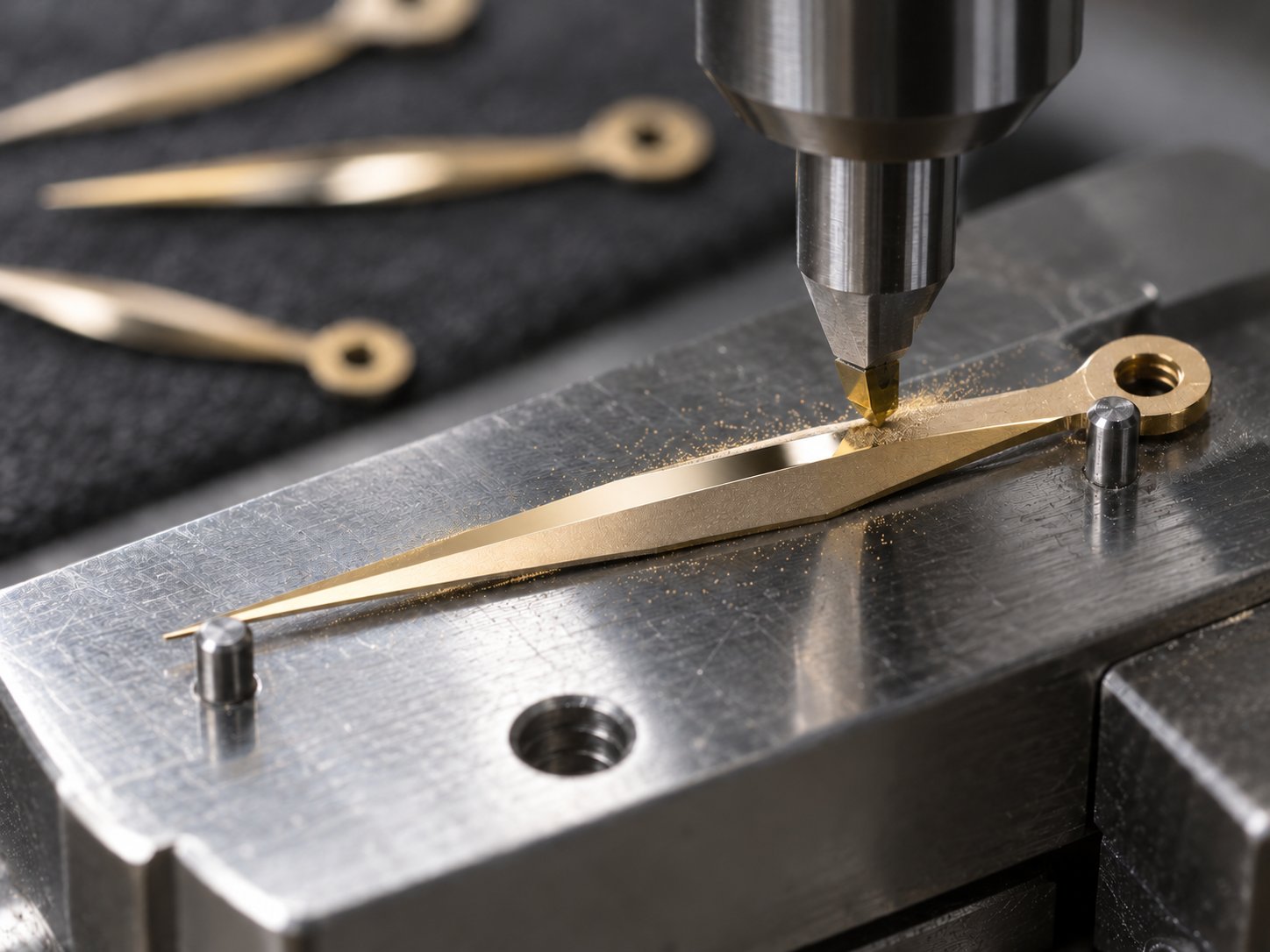
| Diamond cutting (diamantage) | Dials, indexes, appliques, hands | Single crystal diamond tool | Yes |
| Mirror-faced surfaces | Bezels, cases, dials | Diamond facing tool or fly cutter | Yes |
Geneva stripes and perlage: abrasive decorations
Geneva stripes are the straight, parallel bands that catch the light on the bridges and rotor of a fine movement. They are made with a rotating wheel or wooden peg and an abrasive, passed over the part band after band, each one slightly overlapping the last.
Perlage, also called circular graining, is a pattern of small overlapping circles. A rotating peg with abrasive touches the surface again and again, in a regular grid. It is common on main plates and on surfaces that are only visible when the movement is taken apart.
Both are decorations, not cuts. They give texture and light, but they do not make a surface flat or mirror-bright, and no cutting tool is used.
Sunburst dials: a brushed finish
A sunburst dial has fine lines radiating from the center, so the light seems to move across the dial as the watch turns. The lines are brushed with an abrasive brush or belt, usually before the dial is plated or lacquered. Sunburst is often confused with diamond cutting because it is bright, but it is a brushed finish.
Guilloché: engraved, sometimes diamond-cut
Traditional guilloché is engraved on a rose engine: a hand-operated machine that guides a graver along a pattern, line after line. The result has deep, sharp lines that play with the light, and it remains a craft of its own.
Some modern dials with guilloché-like patterns are made on CNC machines instead, with a small single crystal diamond tool. Each line comes out very bright and sharp, and the pattern can be repeated exactly in series.
Anglage: by hand, or a bright chamfer by machine
Anglage is the bevelled, polished edge on movement bridges. In haute horlogerie it is done by hand: the edge is filed at 45 degrees, then smoothed with stones and polished with wood and paste. Inside corners, which no machine can reach, are the signature of hand work.
In series production, a bright chamfer can also be cut by machine with a single crystal diamond chamfer cutter. It does not replace hand anglage, but it gives an even, mirror-bright chamfer on every part, on bridges, cases and bezels.
Diamond cutting: where the diamond tool really works
Diamond cutting, or diamantage, is the finish that is truly made with a diamond. The edge of a single crystal diamond tool is polished so fine and so straight that it leaves a mirror surface in one pass. It is used for:
- Dials: bright bevels, facets and patterns, and flat faces before plating.
- Indexes and appliques: the bright facets that make the hour markers sparkle.
- Hands: mirror facets, for example the two facets of a dauphine hand.
- Cases and bezels: mirror faces and bright edges, cut on a lathe or with a fly cutter.
This works on gold, platinum, silver, brass and copper. Steel and titanium are not cut with diamond, because the carbon in the diamond reacts with them at cutting temperature.
Where Bulunmaz fits
Bulunmaz makes the single crystal diamond tools for the finishes in the last part of this guide: diamond cutting tools for dials, indexes and hands, chamfer cutters, facing tools and fly cutters, and tools for Swiss-type lathes, in natural diamond and MCD, to your drawing. We do not make abrasive decoration tools. See our diamond tools for watchmaking, or send us your part for a quote.
FAQ
- Are Geneva stripes cut with a diamond tool?
- No. Geneva stripes (côtes de Genève) are made with a rotating wheel or peg and abrasive, which is passed over the part in straight, overlapping bands. No cutting tool is involved.
- What is the difference between perlage and Geneva stripes?
- Both are abrasive decorations, often on movement parts. Perlage is a pattern of small overlapping circles, made with a rotating peg. Geneva stripes are straight parallel bands. Perlage is mostly found on plates and hidden surfaces, Geneva stripes on bridges and rotors.
- How is a sunburst dial made?
- A sunburst dial is brushed: fine lines are made with an abrasive brush or belt, radiating from the center. The light then moves across the dial as it turns. It is a brushed finish, not a diamond-cut one.
- Is guilloché cut with diamond?
- Traditional guilloché is engraved by hand on a rose engine, with a graver. Some modern dials with guilloché-like patterns are cut on CNC machines with a diamond tool, which gives very bright, sharp lines in series.
- What is diamond cutting on a watch?
- Diamond cutting (diamantage) means cutting a bright facet, bevel or edge with a tool whose edge is a polished single crystal diamond. The surface comes off the machine like a mirror, without polishing. It is used on dials, indexes, appliques, hands, and on the edges and faces of cases and bezels.
- Can a machine replace hand anglage?
- Not in haute horlogerie, where hand anglage with files, stones and wood remains the reference. For series production, a single crystal diamond chamfer cutter makes even, bright chamfers on bridges, cases and bezels in one pass.
Running a machine and need the tool for it? Send us the material, a drawing or photo and the finish you need.
Request a quoteArticles for watchmakers
All articlesRequest a quote
Tell us about your part
Send the material, the part (dial, hand, bezel, bridge...), your machine and a drawing or photo. We'll suggest the right tool and send you a quote.
- Email: hello@bulunmaztools.com
- WhatsApp: +90 532 561 99 62