
Knowledge · Optics & Lens Molds
How to specify a diamond tool: nose radius, rake angle, clearance and waviness
A single crystal diamond tool is defined by a few numbers: its nose radius or included angle, its rake angle, its clearance angle and, for optics, its edge waviness. Together with the feed, they decide the finish, the shapes the tool can reach and how long the edge lasts. This guide explains each one in plain terms, with typical values, and lists what to send a toolmaker when you order a tool.
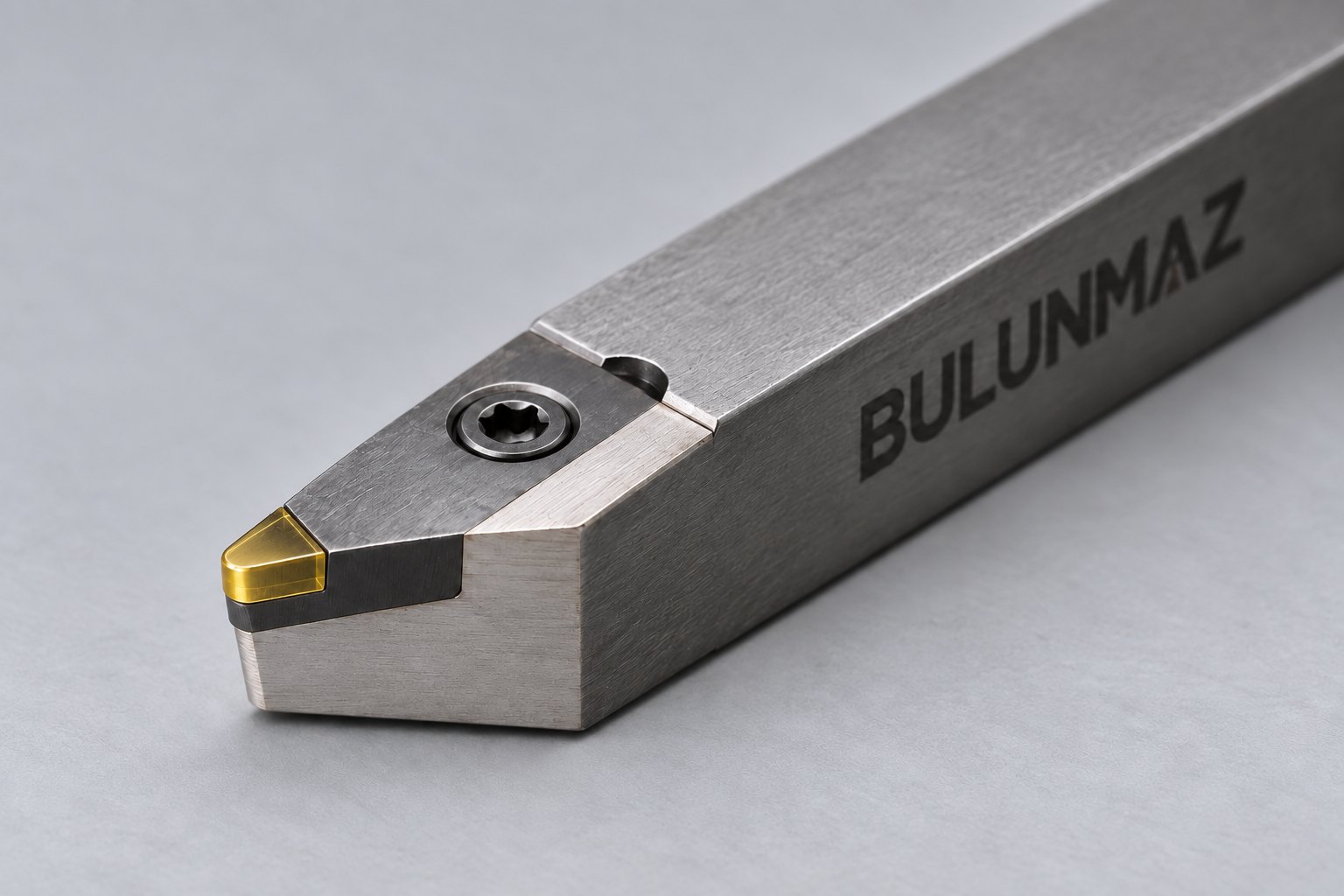
The parts of a diamond tool
A diamond tool is a small diamond, brazed or clamped onto a shank, and polished to a cutting edge. The top face, over which the chip flows, is the rake face. The face below the edge, which faces the cut surface, is the clearance face (or flank). The edge where they meet is either round, with a nose radius, or pointed, with an included angle. Almost everything about how the tool cuts follows from these few features.
Nose radius and feed: what decides the finish
A round-nosed tool leaves a tiny scallop on each turn of the part. Its theoretical height (peak to valley) is roughly:
scallop height ≈ feed² ÷ (8 × nose radius)
For example, a 0.5 mm nose radius at a feed of 0.01 mm per turn gives a theoretical scallop of about 25 nanometers: far below what the eye can see. Halving the feed cuts the scallop by four; doubling the radius halves it. The real surface also depends on the material, the edge quality and the machine, but this rule explains why fine feeds and generous radii are used for mirror finishes.
- Larger radius: smoother surface at the same feed, more forgiving, but cannot reach small radii or sharp internal corners on the part.
- Smaller radius: reaches fine details and steep slopes, but needs a finer feed for the same finish and carries less load.
- Pointed (V) tools: defined by the included angle, for example 60° or 90°. Used for grooves, Fresnel patterns and decorative lines; the tip is the weakest point.
Rake angle
The rake angle is the tilt of the top face relative to a line through the edge and the center of the part.
- 0° rake: the usual choice for diamond tools on aluminum, copper, brass, precious metals and plastics. It balances edge strength and a clean cut.
- Negative rake (for example −25°): for brittle materials such as germanium and silicon. It compresses the material at the edge so it cuts as a fine chip instead of cracking.
- Positive rake: cuts more freely with lower forces, sometimes used on soft or sticky materials, but the edge is weaker and chips more easily.
Clearance angle
The clearance angle stops the face below the edge from rubbing on the cut surface. It must be large enough for the steepest part of the surface the tool will cut, otherwise the flank touches and spoils the surface. But every extra degree takes support away from the edge. Diamond tools typically have a clearance of a few degrees up to around ten to fifteen degrees, chosen for the part.
The clearance face can be conical or cylindrical. A conical clearance falls away from the edge and gives a sharper tool; a cylindrical clearance keeps the same shape below the edge, is more rigid, and keeps its radius better when the tool is relapped.
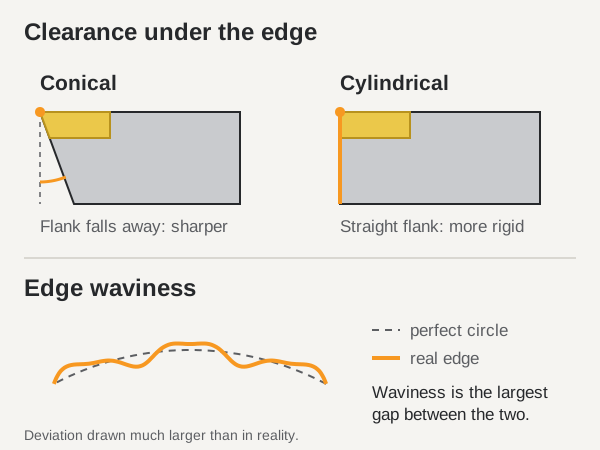
Edge waviness
Waviness is how far a round edge deviates from a perfect circle. For decorative work it rarely matters. For optics and lens molds, the edge shape is printed directly into the surface, so optical tools are made and measured with a controlled waviness, typically from about 1 µm down to 50 nm or better. Ask for the waviness only if your part needs it: tighter waviness costs more.
Center height and setting
The tool tip must sit exactly at the height of the spindle center. If it is above or below, the tool cannot cut to the center when facing and leaves a small pip or ring, and the effective rake and clearance angles change. With diamond tools, the setting has to be very precise. Tools made with a tight tolerance on tip height, and holders that allow fine adjustment, make this much easier.
Crystal orientation
Diamond is harder in some crystal directions than in others. A good toolmaker orients each stone so the edge works in a wear-resistant direction. You do not specify this yourself, but it is one reason two tools with the same geometry can last very differently. See our guide to natural diamond, MCD and CVD.
Typical starting points
| Job | Edge | Rake | Notes |
|---|---|---|---|
| Mirror facing and turning of aluminum, brass, copper | Radius, often 0.5 to 2 mm | 0° | Fine feed, light finishing pass |
| Optical surfaces and lens molds | Radius, controlled waviness | 0° | Clearance chosen for the steepest slope |
| Germanium, silicon and other IR crystals | Radius | Negative, often around −25° | Very small depth of cut |
| Grooves, Fresnel and V-patterns | V, included angle to the drawing | 0° | Sharp tip, light cuts |
| Acrylic edges and faces | Straight or radius | 0° or slightly positive | Clean, cool cut |
These are starting points, not rules. The right geometry depends on the part, the machine and the batch size.
What to send when you order a tool
- The material you cut, and the finish you need.
- The machine and the tool holder (shank size, length, any special clamping).
- A drawing of the part or of the tool, or a sample or photo of the tool you use today.
- If you know them: nose radius or included angle, rake, clearance and, for optics, waviness. If you do not, we propose them.
What Bulunmaz does
Bulunmaz makes single crystal diamond tools in natural diamond and MCD to the radius, angles and shank on your drawing, sends a tool drawing for approval before production, and resharpens the tools when the edge wears. See our custom diamond tools and diamond turning tools for optics and lens molds.
FAQ
- What is the rake angle of a cutting tool?
- The angle of the top face of the tool (the face the chip slides over) relative to a line through the cutting edge and the center of the part. A positive rake cuts more freely but makes the edge weaker; a negative rake makes the edge stronger. Diamond tools for metals and plastics usually have a 0° rake; tools for brittle infrared crystals have a negative rake, often around −25°.
- What is the clearance angle?
- The angle between the face below the cutting edge and the cut surface. It stops the tool rubbing behind the edge. It must be large enough for the steepest part of the surface, but every extra degree makes the edge less supported.
- How does nose radius affect surface finish?
- With a round-nosed tool, each turn of the part leaves a tiny scallop. Its theoretical height is about feed² ÷ (8 × nose radius). A larger radius or a smaller feed gives a smoother surface; a smaller radius is needed to reach small or steep features.
- What is edge waviness?
- How far the round edge of a radius tool deviates from a perfect circle. In optics, that error is copied into the surface, so optical tools are made with a controlled waviness, typically from about 1 µm down to 50 nm or better.
- Why does tool center height matter?
- If the tool tip is above or below the spindle center, it cannot cut to the exact center when facing, and leaves a small pip or a ring there. It also changes the effective rake and clearance angles. Diamond tools need to be set very precisely on center.
- What should I send to order a diamond tool?
- The material, the surface finish you need, the machine and tool holder, and a drawing or a sample of the current tool. If you know them, add the nose radius or included angle, rake and clearance. If not, we propose the geometry.
Running a machine and need the tool for it? Send us the material, a drawing or photo and the finish you need.
Request a quoteArticles for optics makers and mold shops
All articlesWhich materials can be cut with a diamond tool, and why not steel
Request a quote
Tell us about your part
Send the material, a drawing or photo, and the finish you need. We'll suggest the right tool and send you a quote.
- Email: hello@bulunmaztools.com
- WhatsApp: +90 532 561 99 62