
Knowledge · Ophthalmic
How intraocular lenses are lathed: from blank to finished IOL
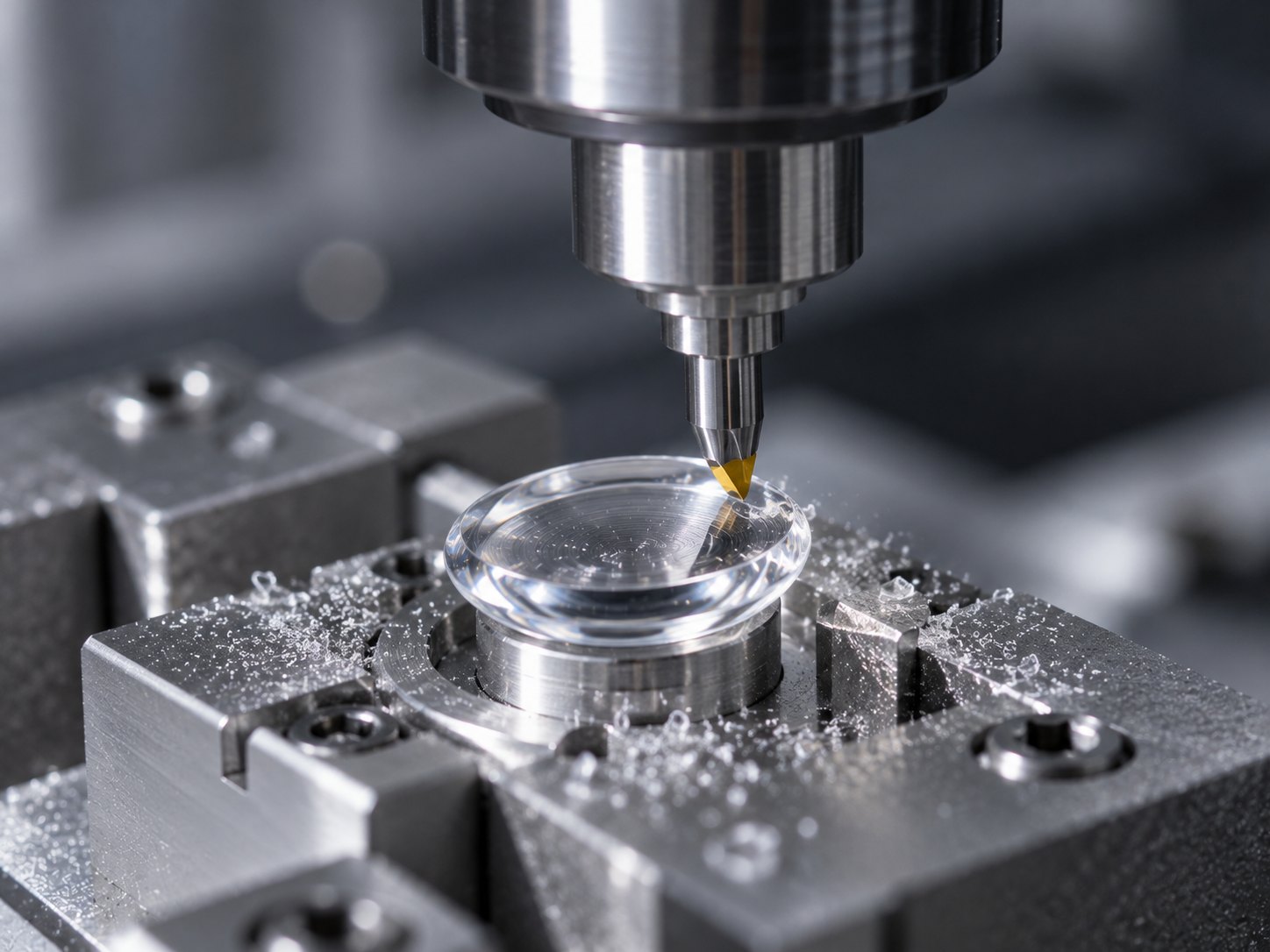
An intraocular lens (IOL) is a small artificial lens placed inside the eye, most often to replace the natural lens in cataract surgery. It is only about 13 mm across with its support arms, and its optic is a precision optical surface. Many IOLs are made on precision lathes and small milling machines with single crystal diamond tools. This guide explains the parts of an IOL, the materials, and the steps from blank to finished lens.
The parts of an IOL
- The optic: the round central lens, usually about 6 mm across. Its front and back surfaces give the optical power; many designs are aspheric, and toric IOLs also correct astigmatism.
- The haptics: two thin, flexible arms that hold the lens centered in the eye.
- One-piece IOLs are cut, optic and haptics, from a single blank of material.
- Three-piece IOLs have an optic made separately and two haptics of another material attached to it.
Materials
| Material | Lens type | How it is made |
|---|---|---|
| Hydrophobic acrylic | Foldable | Lathed (some makers cool the material) or molded |
| Hydrophilic acrylic | Foldable | Lathed dry, hydrated afterwards |
| PMMA | Rigid | Lathed |
| Silicone | Foldable | Usually molded |
For more on lens materials, see what contact lenses are made of.
From blank to finished IOL
- Blank. A small disc or button of the lens material, produced and inspected for clarity and stress.
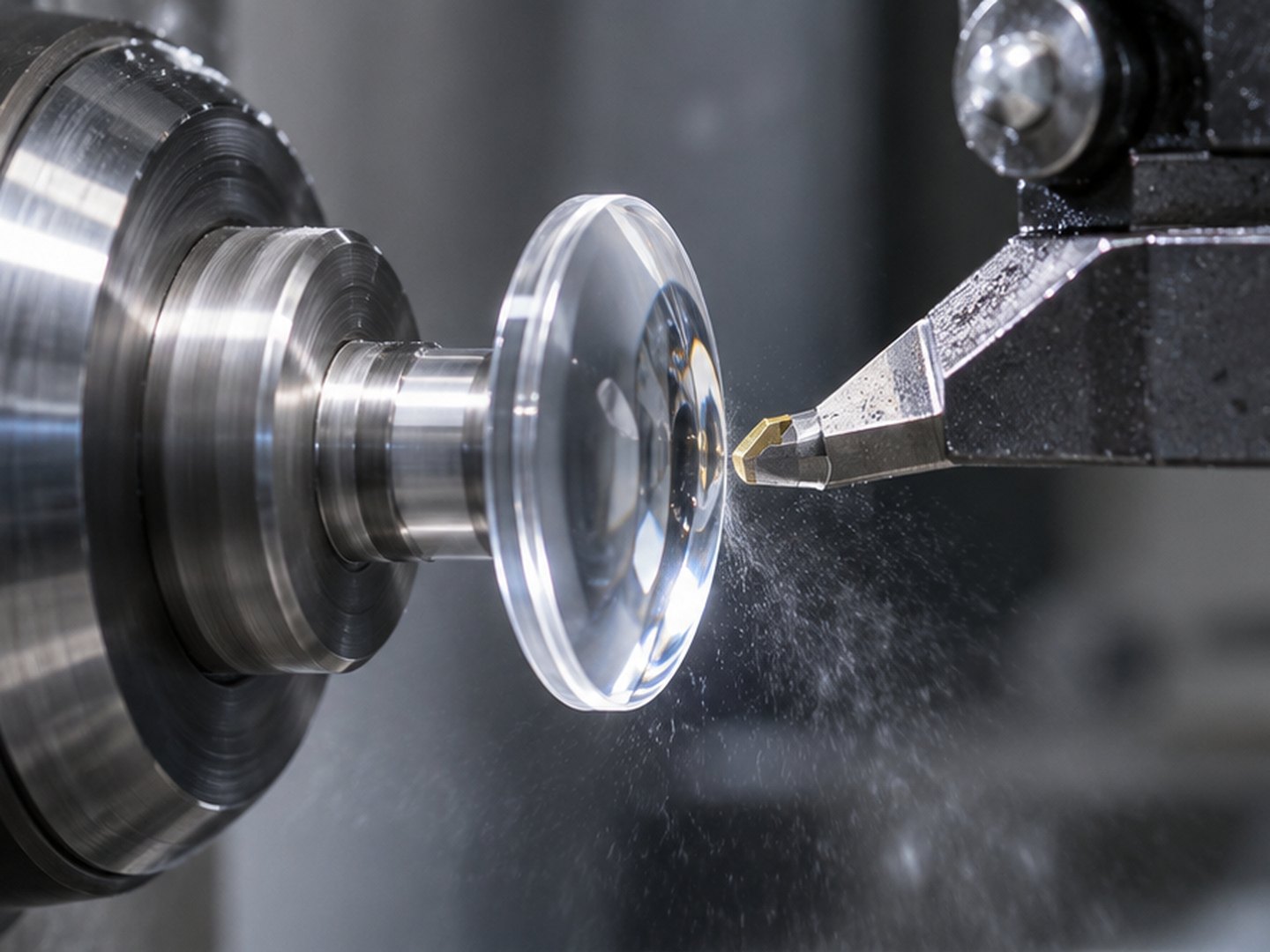
- Lathing the back surface. On a precision lathe with an air-bearing spindle, a single crystal diamond radius tool cuts the posterior optic surface.
- Lathing the front surface. The blank is remounted and the anterior surface is cut. Aspheric profiles follow the tool path; toric surfaces need a lathe with an oscillating tool (fast tool servo).
- Milling the haptics. On one-piece lenses, very small end mills cut the outline of the optic and the thin haptic arms from the same blank, on a small high-speed milling machine.
- Edge and surface finishing. The optic edge is given its designed shape; depending on the design and material, the lens may be lightly polished.
- Inspection. Power, surface quality, dimensions and the haptics are checked under magnification.
- Hydration, cleaning, sterilization and packaging, as the material requires.
What the tools have to do
- Optical surfaces straight from the lathe. The radius tool's edge is copied into the optic, so it must be sharp, even and free of chips. See what polish-free lathing demands from the tool edge.
- Clean haptics. The haptic cutters are tiny, and the arms are thin and flexible; a sharp edge cuts them cleanly without tearing or burrs.
- A precise edge on the optic. The designed edge, often a sharp square edge on the back, has to come out the same on every lens.
- Tools that fit the machines. IOL lathes and milling machines take their own holders and shanks; the tool tip must sit exactly on center.
What Bulunmaz does
Bulunmaz makes single crystal diamond tools in natural diamond and MCD for IOL production: radius tools for the optic, inserts, and small cutters for milling haptics, made to your drawing and holder, and resharpens them. We do not make lenses. This article describes manufacturing; it is not medical advice. See our diamond tools for lathe-cut contact lenses and IOLs.
FAQ
- How are intraocular lenses made?
- Many are made by lathing: the optic surfaces are cut from an acrylic or PMMA blank with a single crystal diamond tool, and on one-piece lenses the haptics are then milled from the same blank. Others, especially silicone IOLs, are molded.
- What is the difference between a one-piece and a three-piece IOL?
- In a one-piece IOL, the optic and the support arms (haptics) are cut from the same piece of material. In a three-piece IOL, the optic is made separately and two thin haptics of another material are attached to it.
- What are haptics on an intraocular lens?
- Haptics are the thin support arms that hold the IOL in position inside the eye. On one-piece lenses they are milled from the same blank as the optic with very small cutters.
- Why are some IOLs cut while cold?
- Some hydrophobic acrylics are soft and flexible at room temperature, which makes a clean cut hard. Some makers cool the material during lathing so it cuts like a rigid material; others mold these lenses instead.
- Why does the IOL edge matter?
- The edge of the optic is a designed feature, not only a cut-off. Many modern IOLs have a deliberately sharp, square edge on the back of the optic, so the edge geometry has to be cut precisely and consistently.
- Does Bulunmaz make intraocular lenses?
- No. Bulunmaz makes the single crystal diamond lathe tools and haptic milling cutters that IOL makers use on their own machines.
Running a machine and need the tool for it? Send us the material, a drawing or photo and the finish you need.
Request a quoteArticles for lens laboratories
All articlesWhat are contact lenses made of? Lens materials and how each is made
What polish-free lathing demands from the tool edge
How to specify a diamond tool: nose radius, rake angle, clearance and waviness
Resharpening single crystal diamond tools: when, how often, and what it costs
Which materials can be cut with a diamond tool, and why not steel
Request a quote
Tell us about your part
Send the lens material, the lens type (scleral, RGP, ortho-k, soft, IOL...), your lathe and a drawing or photo of your current tool. We'll suggest the right tool and send you a quote.
- Email: hello@bulunmaztools.com
- WhatsApp: +90 532 561 99 62