
Knowledge · Ophthalmic
What polish-free lathing demands from the tool edge
Many lens labs aim to cut lenses that need no polishing at all: the surface that leaves the lathe is the finished optical surface. Polish-free lathing saves time and keeps the exact shape that was cut, but it only works when the tool edge, the lathe and the material are all right. This guide explains what polish-free lathing demands, with the tool edge first.
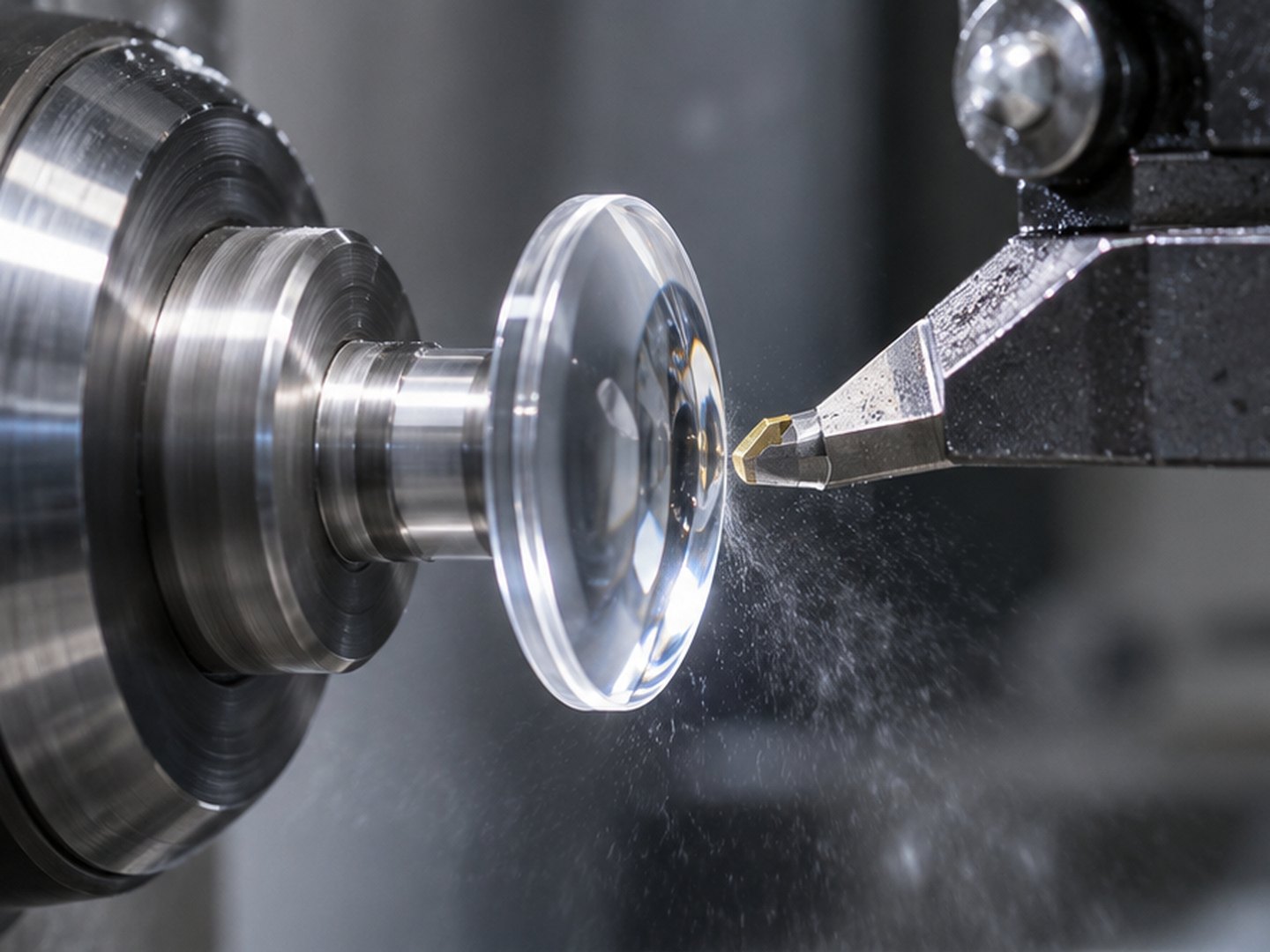
Why lathe without polishing
- Shape: polishing removes a little material unevenly. On complex designs, such as ortho-k reverse zones, toric surfaces or the large back surface of a scleral lens, it can change the geometry the lathe cut so precisely.
- Time and handling: one step less per lens, and fewer chances to scratch or contaminate it.
- Consistency: the result depends on the tool and the lathe, not on a polishing operator.
What the tool edge must deliver
On a polish-free lens, every feature of the edge appears in the optical surface. These are the points that matter:
- A truly sharp edge. The edge has to cut the material cleanly rather than push or smear it. Single crystal diamond, natural or MCD, is the only tool material that can be polished this sharp.
- No chips, not even tiny ones. A chip invisible to the eye draws a ring on every lens. Edges for polish-free work are inspected under high magnification.
- The right nose radius for the feed. Each turn leaves a tiny scallop whose height is roughly feed² ÷ (8 × nose radius); the finishing radius and feed are chosen so these marks are far too small to matter optically.
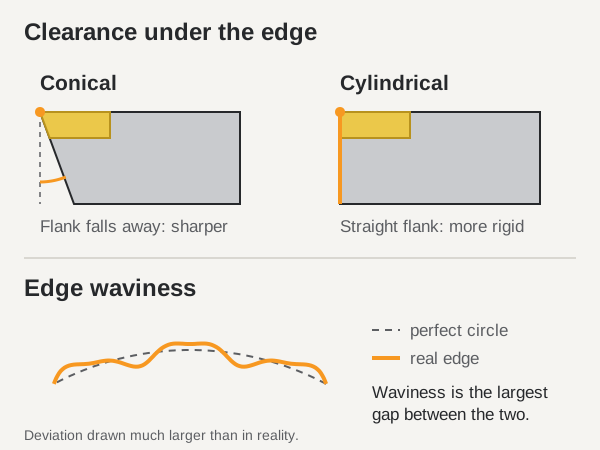
- Controlled waviness. The round edge must be very close to a perfect circle, because any waviness is printed into the lens surface.
- Rake and clearance for the design. Usually a neutral rake, and enough clearance for the steepest zone of the lens, such as reverse zones or a deep scleral back surface, without the flank rubbing.
For the geometry in detail, see diamond tool geometry: nose radius, rake, clearance and waviness.
What the lathe and the setup must deliver
- A stable spindle without runout, typically on air bearings, and a rigid machine; vibration shows directly on the lens.
- The tool exactly on center. A tool above or below center leaves a small pip or ring at the lens center.
- A light, steady finishing cut after roughing, with an even allowance.
- Clean chip removal, so chips do not drag across the fresh surface.
What the material must deliver
- Consistent buttons: stress-free and from a consistent batch; the same settings can behave differently on another material.
- The right condition: hydrogels must be fully dry when cut; some soft materials need cooling to cut cleanly.
- Stable temperature, so the material and the machine do not move during the cut.
Keeping it polish-free: tool care
A diamond edge wears slowly, and on polish-free work the first sign is on the lenses: a slight haze, faint rings, or lenses that suddenly need polishing. Many labs track how many lenses each finishing tool has cut and change it on a schedule, before the quality drops. A worn edge is not the end of the tool: it can be relapped to its original radius and waviness. See resharpening diamond tools.
What Bulunmaz does
Bulunmaz makes single crystal diamond finishing tools for contact lens and IOL lathes in natural diamond and MCD, with the nose radius, rake, clearance and waviness your lenses need, inspects every edge, and resharpens tools when they wear. See our diamond tools for lathe-cut contact lenses and IOLs.
FAQ
- What is polish-free lathing?
- Cutting the optical surfaces of a lens so well on the lathe that no polishing step is needed afterwards. The lathed surface is the finished surface.
- Why do lens labs prefer polish-free lathing?
- Polishing takes time and handling, and it can slightly change the shape that was cut, especially on complex designs such as ortho-k, toric or scleral lenses. Without polishing, the lens keeps exactly the geometry the lathe produced.
- What tool is needed for polish-free lathing?
- A single crystal diamond finishing tool with a sharp, even, chip-free edge, the right nose radius for the feed, controlled waviness and the right rake and clearance for the lens material and design.
- How do I know when the tool is no longer good enough?
- The lenses show it first: a slight haze, fine rings or lines, or a need to polish lenses that used to come off clean. At that point the edge should be inspected and resharpened.
- Can every lens be lathed without polishing?
- Not always. The material, the design and the lathe all play a part. Many labs lathe most lenses polish-free and polish only certain designs or materials lightly.
Running a machine and need the tool for it? Send us the material, a drawing or photo and the finish you need.
Request a quoteArticles for lens laboratories
All articlesWhat are contact lenses made of? Lens materials and how each is made
How intraocular lenses are lathed: from blank to finished IOL
How to specify a diamond tool: nose radius, rake angle, clearance and waviness
Resharpening single crystal diamond tools: when, how often, and what it costs
Which materials can be cut with a diamond tool, and why not steel
Request a quote
Tell us about your part
Send the lens material, the lens type (scleral, RGP, ortho-k, soft, IOL...), your lathe and a drawing or photo of your current tool. We'll suggest the right tool and send you a quote.
- Email: hello@bulunmaztools.com
- WhatsApp: +90 532 561 99 62